Edge vs Cloud in Manufacturing: Where Machine and Camera Data Should Be Processed
DBR77 Team · Published
In manufacturing, process machine and camera data at the edge, inside the plant, when you need fast reaction, offline operation, low network load or tight control of personal data. Use the cloud for what no single hall needs on its own: analytics across several sites and heavy compute you do not want to own.
DBR77 runs edge-first. Processing happens on site, inside the plant's IT/OT boundary, and no raw floor data is shipped to a public cloud by default. This article explains why, which signals deserve edge logic, and how the three deployment options compare.
What edge and cloud mean on a factory floor
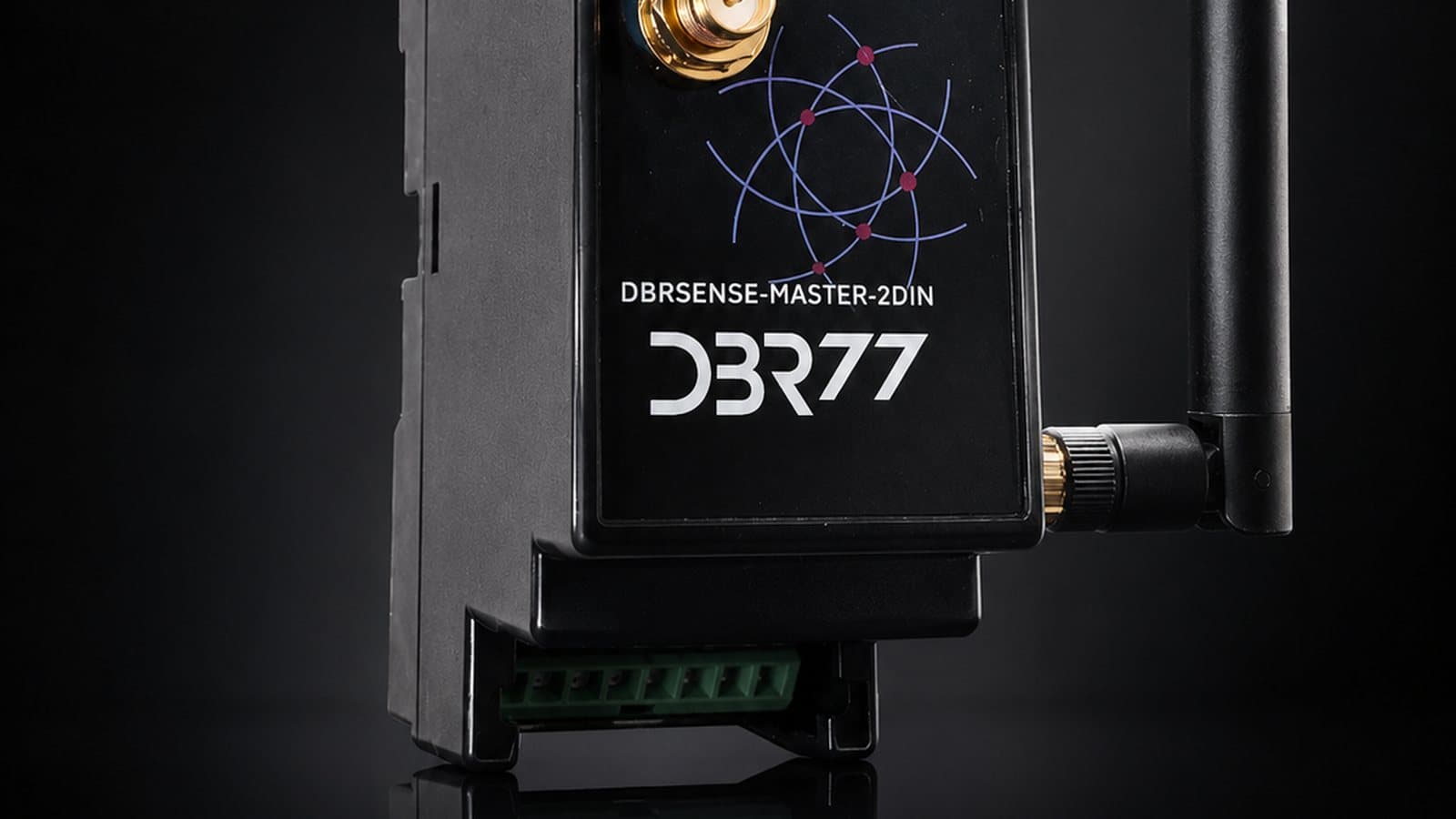
"Edge" covers two places. The first is a small computer at the machine or station. The second is a server in the plant, usually in a hall's network room. Both stay inside your fence and your firewall.
"Cloud" means a data center outside the plant, your company's tenant or a provider's. It is good at scale and storage, and weak when the internet link drops or data must not leave the site.
The useful split is between raw signals and video, which are heavy and sensitive, and events such as "press 4 stopped at 10:42, reason: material", which are light and easy to share.
When edge processing is worth it for machine signals
Four reasons decide it:
- Latency. A stop must become an alert in seconds. A round trip to a distant data center adds delay and a point of failure.
- Offline operation. Halls lose network. An edge device keeps counting cycles and stops, then syncs when the link returns.
- Bandwidth. For example (illustrative numbers), one vibration sensor sampling at 10 kHz with 2-byte values produces about 1.7 GB a day. Sending features, such as RMS per minute, is a tiny fraction of that.
- Data protection. What never leaves the site needs fewer contracts and fewer approvals.
The signals that need edge logic are state changes, stop detection with a minimum duration, cycle counting and high-frequency signals such as vibration or motor current. OEE, downtime Pareto and shift reports can be calculated from the resulting events anywhere. Our guide to connecting old machines without a PLC shows which edge devices read which signals.
The first question IT asks about cameras
With cameras the debate gets sharper. In Vision AI projects the first question from IT is almost always: "Where does the footage from our hall go?"
That question goes to the data protection impact assessment, the data protection officer and the contract, where "in a secure cloud" is too weak an answer. Under Article 35 of the GDPR, a controller must assess high-risk processing before it starts, and cameras that see employees invite that review.
The Vision AI layer in IRIS does not record video by design. Frames are analyzed on site, the system keeps events such as cycle times or presence, and the images are discarded. In our experience, "we process locally and do not store" takes about two meetings with the DPO, while "we send it to the cloud and store it" takes about two quarters. See when cameras beat a sensor for where vision makes sense at all.
Bring your IT and OT questions to a demo
In 30 minutes we show where DBR77 processes machine and camera data, what leaves the site, and what your DPO will want to see.
Three deployment options compared
The same application and the same models run in all three options; what changes is where inference happens.
| Option | Where processing happens | Best for | Trade-off |
|---|---|---|---|
| Compact edge computer at the station | On a small NVIDIA Jetson device next to the machine or camera | A pilot station, remote areas, stations that must work offline | One box per station; limited compute per device |
| Hall concentrator | On premises, on an NVIDIA Jetson AGX Thor serving 40 to 60 cameras at 1080p | A typical 5,000 to 10,000 m² hall | Needs rack space, power and a hall network |
| GPU in the cloud | In the customer's or DBR77's cloud tenant | Multi-site analytics and scale across plants | Data leaves the site, so DPIA and contracts take longer |
The hardware is built for this work. NVIDIA's Jetson Orin modules run from about 7 W to 60 W in small form factors. Jetson AGX Thor has 128 GB of memory and runs within a 130 W power envelope, enough for a hall of cameras.
How to grow from one box to many sites
Because the application stays the same, scaling means adding hardware:
- Start with one box at a pilot station. Prove the use case and the data protection setup on a small scale.
- Grow to one concentrator per hall. Move inference from station boxes to the hall when camera count justifies it.
- Add cloud for multi-site analytics. Send events to the cloud to compare plants while raw data stays on site. Nothing needs to be migrated because the models are the same.
After a year, the questions shift to who owns which data and models; see IoT governance after the first year.
Security, NIS2 and model licences
The NIS2 Directive sets cybersecurity risk-management and incident-reporting duties for medium and large entities in critical sectors, including critical product manufacturing. In Poland, the amended National Cybersecurity System Act that implements it has applied since 3 April 2026. Processing inside your IT/OT boundary keeps the attack surface smaller. ISA/IEC 62443 remains the reference for securing industrial control systems. Our security page describes the DBR77 setup.
Check model licences too. Some popular open-source vision models are released under the GNU AGPL. Its Section 13 requires that a modified version used over a network offer its source code to users. That requirement can clash with a commercial product, so DBR77 uses models licensed for commercial use.
Questions to ask any vendor:
- Where exactly does inference run, and what leaves the site?
- Is any video or raw signal stored, where, and for how long?
- Can the system run if the internet link is down?
- Which licences cover the AI models?
FAQ
Is edge processing more expensive than cloud?
Edge needs hardware upfront. Cloud adds ongoing costs for compute, data transfer and storage. For one hall, edge is usually simpler; cloud pays off when you compare many sites.
Can we use the cloud later without starting again?
Yes, if the same application and models run in both places. You then send events to the cloud for cross-site analytics and keep inference local.
Does processing on site remove the need for a DPIA?
No. If cameras can see people, the DPO will still assess it. Local processing without recording makes that assessment shorter and easier.
What happens when the network goes down?
Edge devices keep collecting and analysing data, buffer the events and send them when the connection returns. Alerts within the hall keep working.
Which machine signals should stay at the edge?
High-frequency signals such as vibration and motor current, and the logic that turns raw states into events. Aggregated events can go anywhere.
Conclusion
Keeping raw signals and camera frames inside the plant and sending only events onward gives IT and the DPO a direct answer to "where does the data go?" Start by choosing one station for a compact edge box, and use it to prove the use case and the data protection setup before you plan a hall concentrator.
See the edge-first setup in a demo
We show the station box, the hall concentrator and the cloud option, and help you pick the right start for one of your halls.
Sources
- NVIDIA, NVIDIA Blackwell-Powered Jetson Thor Now Available, 2025
- NVIDIA, Jetson Orin for next-gen robotics, 2026
- Intersoft Consulting (GDPR text), Art. 35 GDPR: Data protection impact assessment, 2016
- European Commission, NIS2 Directive: securing network and information systems, 2026
- Ministry of Digital Affairs (Poland), Nowelizacja ustawy o krajowym systemie cyberbezpieczeństwa zaczyna obowiązywać, 2026
- ISA, ISA/IEC 62443 series of standards, 2026
- Free Software Foundation, GNU Affero General Public License v3, 2007
- DBR77 IRIS Vision AI deployment specifications (edge-first architecture), 2026