From Sensors to Decisions: How Industrial Data Actually Flows
Industrial data pays rent at the moment it changes a decision. Everything before that—installation, buffering, storage, a slick chart—is overhead unless it shortens the path from “something happened”…

Capture is the opening move, not the victory
Signal sources are diverse: PLCs, sensors, gateways on legacy equipment, operator input. Capture matters, but it is only the first link. Teams that over-invest in ingestion and under-design the next steps often celebrate “we are live” while behavior on the line barely moves.
Treat capture as the beginning of a chain you can describe in plain language: from the machine, through structure and meaning, to a person who can authorize motion, and back to a review that turns repeats into policy.
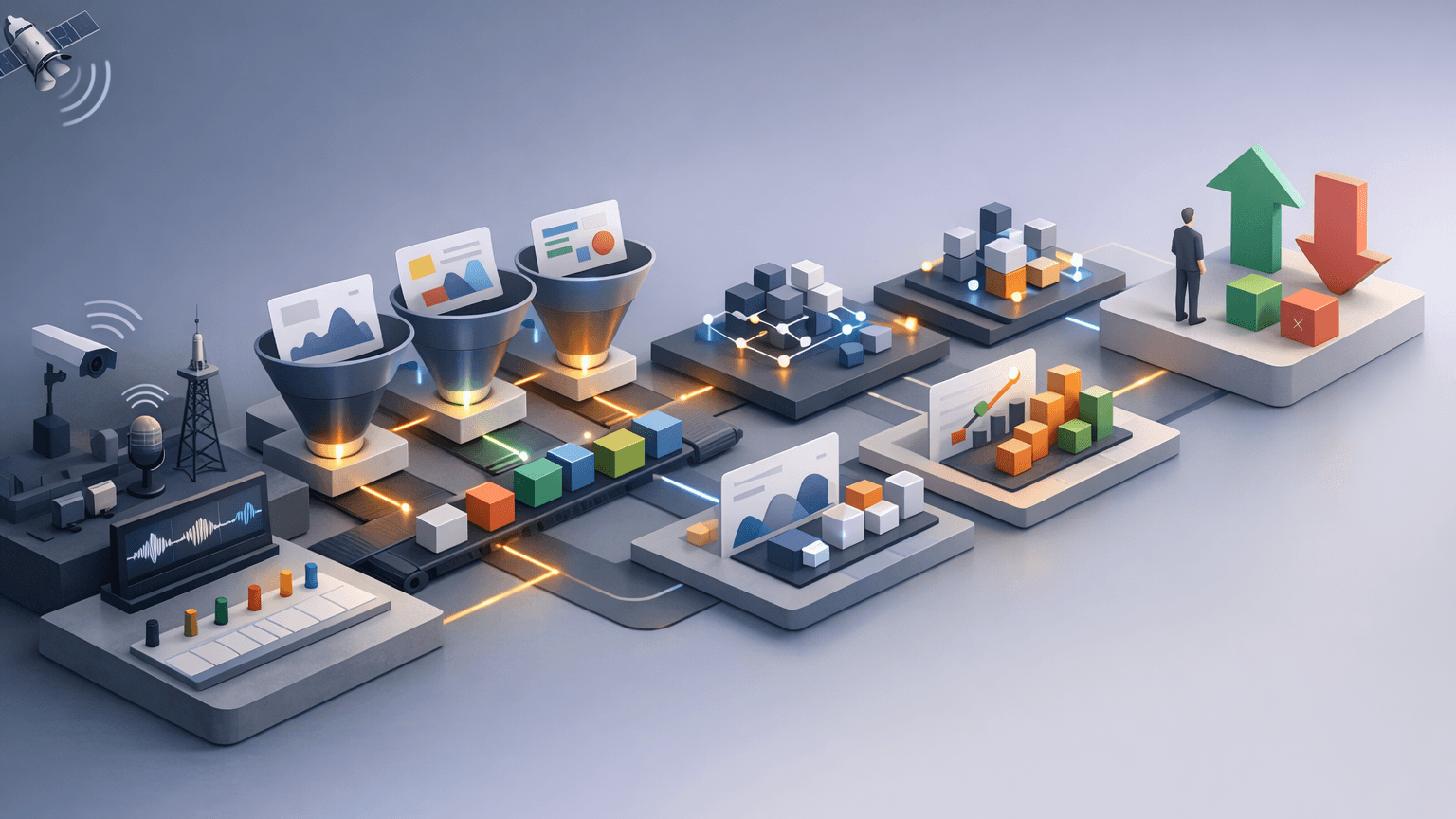
Structure is where trust is won or lost
Raw industrial streams are noisy. Timestamps drift. States need normalization. Events need consistent naming so second shift does not debate what first shift meant by “stop.” Without discipline here, dashboards become arguments with colors.
Invest early in the boring foundations: aligned time, stable asset identity, clear state models, and separation between signal and interpretation. Fragile structure upstream makes every downstream promise brittle.
Context turns events into explanations
A line stop is a fact. The useful question is whether it was a material gap, a tooling issue, a quality hold, or a planned changeover that did not get labeled like one. Context includes order and product, shift ownership, maintenance relevance, and the structured reasons people on the floor already know how to give—if the system makes that easy instead of treating it as paperwork.
Skip context and you get visibility without diagnosis. Add context in the wrong place—only in a meeting three days later—and you get theater.
Rules are the bridge to behavior
Data architecture without decision rules produces passive observation. The plant needs explicit logic for what constitutes abnormal, who is notified first, when escalation is appropriate, and what should become a task instead of a chart.
This is where many programs stall: the moment someone must decide whether an alert is allowed to interrupt a running line. Weak rules create noise. Absent rules create drift. Strong rules are negotiated with the floor, not imposed from a slide deck.
Delivery is timing dressed up as UX
If a supervisor discovers a pattern next Monday, the data may still be interesting. It is no longer a control instrument for the shift that created the pattern. Industrial flow is powerful when operators can respond now, maintenance can join with context, and leadership can see whether recovery is actually happening—not whether a metric eventually turned green in hindsight.
Close the loop or inherit the same problem twice
A complete path is not signal-to-dashboard. It is signal-to-context-to-response-to-review-to-change. When the loop closes, the plant stops documenting the same loss as if it were novel. When it stays open, IIoT becomes expensive instrumentation for recurring surprise.
Why flows break in the real plant
Disconnection between systems, unclear ownership, alert fatigue, and operators left outside the information path all produce the same symptom: technically live, operationally blind. Brownfield makes this harder, not easier—mixed protocols, uneven networks, and legacy assets reward architectures that work without perfect conditions.
DBR77 IoT and the full path
DBR77 IoT is pitched around the flow, not the connector: machine and sensor inputs, operator declarations, real-time OEE-style logic where it fits, alerts and escalation, and execution-oriented visibility on the floor. That framing matches what factories actually mean when they say they want better data—they want a shorter distance between event and disciplined response.
Industrial data only matters when it moves through a usable decision path. Design the chain on purpose—signal, structure, context, rule, response, learning—and sensing stops being a project and starts becoming part of how the plant runs.
DBR77 IoT connects machine signals, operator context, alerts, and same-shift visibility into one usable flow from event to action. Plan a pilot or See online demo.