How to Decide Which IoT Signals Deserve Edge Logic
Edge logic is a placement decision about accountability, uptime, and auditability—not a slogan about being modern.
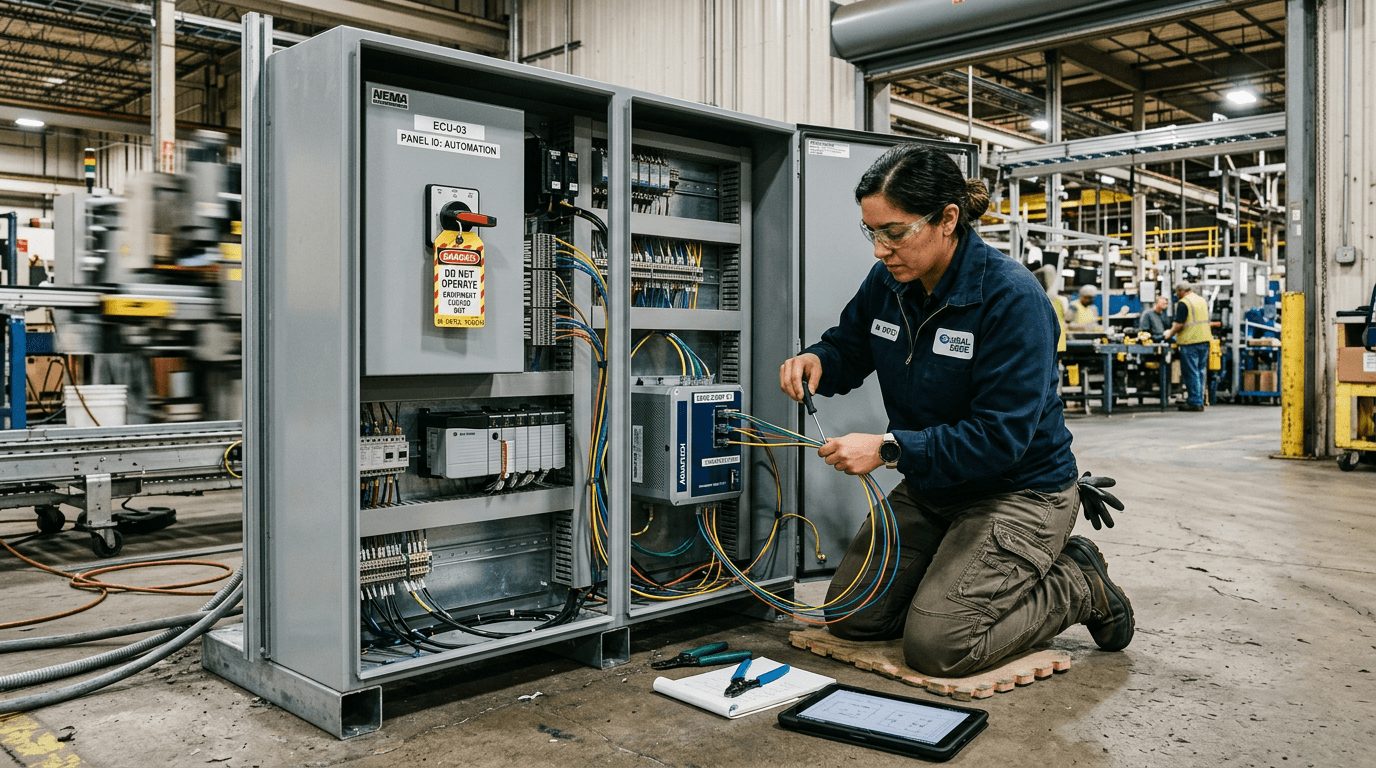
When edge logic earns its place
Favor local execution when sub-second response matters for safety or output, when WAN impairment cannot be allowed to stall minimal intelligence, when raw streams are too heavy or too sensitive to ship continuously, or when deterministic interlock behavior must align with documented standards. These are situations where “call the cloud” is the wrong first instinct.

When central logic remains appropriate
Centralize when the value is cross-line correlation, portfolio analytics, or infrequent batch optimization—and when latency tolerance is honest. Not every calculation deserves a permanent home on the line.
Maintainability is non-negotiable
Edge logic needs patch ownership, backup, recovery, and change control like any OT asset. If the plant cannot maintain it, edge becomes hidden fragility. Document who approves changes, how rollback works, and how audits read the trail.
Pair placement with data quality
Garbage at the edge is still garbage—only faster. Identity, timestamps, and signal meaning still come from the discipline in how to improve machine data quality before scaling IoT. Boundary economics belong with when edge processing is worth it in brownfield IoT.
Edge placement check: latency and outage behavior documented; maintainability owner named; audit trail for logic changes; rollback tested; central layer still answers portfolio questions where needed.
Document two pages only
Page one: signals that must run locally and why. Page two: how patches, backups, and rollbacks happen. If those pages do not exist, edge logic is a hobby.
DBR77 IoT and accountable placement
DBR77 IoT supports thoughtful edge use when local gating ships with transparency, lifecycle ownership, and clarity about what remains central for scale.
Decide edge logic by latency, safety, bandwidth, outage behavior, and maintainability—not by fashion. Placement should make the line safer and clearer, not merely closer to the metal.
Keep the article’s promise practical
Translate the ideas above into one habit your plant can sustain next month: a review that happens, a dictionary people open, a routing rule people trust, or a drill people run. Big programs stall when everything moves at once. Small loops compound when they repeat.
A leadership checkpoint for the next ops review
Ask one plain question: what changed on the floor this month because IoT made reality clearer—not louder? If the answer is vague, tighten scope, definitions, or review cadence before expanding footprint. Useful IoT shows up as calmer handovers, faster confirmation, and fewer circular arguments about what happened. Connection counts are inputs; behavior change is the receipt.
Bringing it home on the floor
None of this advice matters if it stays in a steering deck. The useful test is whether the next shift can act with less debate: clearer states, fewer mystery stops, faster confirmation, and escalation that respects attention. When IoT is working, the line feels less like a courtroom and more like a coordinated team—still loud, still busy, but oriented around the same facts.
If you walk the floor and people still describe the system as “the computer” instead of “our picture of the line,” keep tightening context, ownership, and review until the language changes. Language lag is a symptom that the loop is still too thin.
DBR77 IoT supports edge and hybrid logic placement with retrofit-friendly deployment and clear ownership for local versus central processing. Plan a pilot or See online demo.