What a Good Machine State Model Looks Like Before Scaling IoT
Scaling IoT before you agree on machine state is how plants multiply sensors and arguments at the same time.
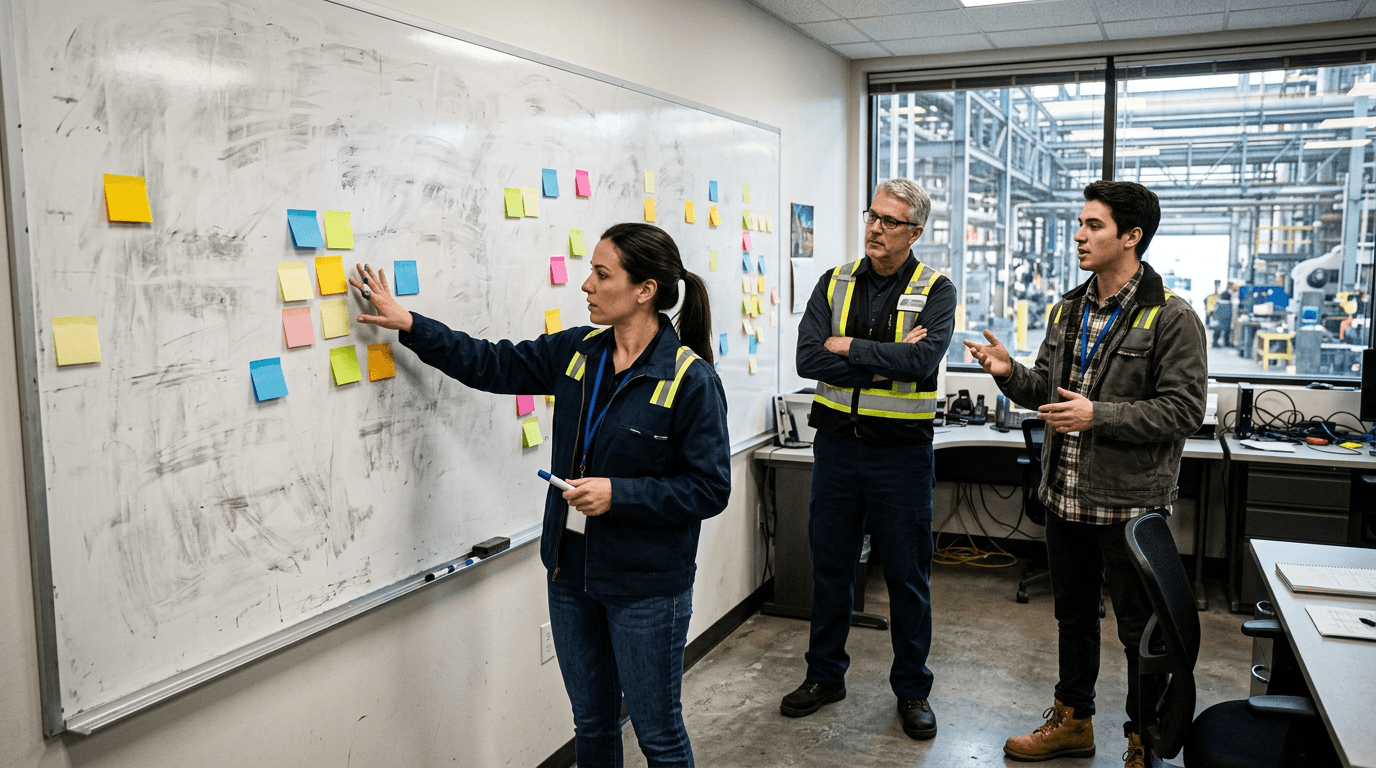
States are commitments; tags are depth
Tags can proliferate for engineering analytics. States should stay few and mutually exclusive for a given moment on an asset. States drive playbooks now; tags can inform later studies. If you cannot draw the state diagram on one page, you are not ready to scale.

A six-state starter you can adapt
Name them for your culture, keep the logic: running to plan within agreed variance; running constrained by material, tooling, staffing, or upstream flow; stopped for planned work such as changeover; stopped unplanned with owner path; held for quality or regulatory reasons; unknown temporarily with a time-bound follow-up. Unknown is legitimate short term; it becomes a defect if it becomes permanent camouflage.
Every transition needs evidence and ownership
Transitions should tie to signals, physical checks, or operator confirmations—not vibes. When a state implies a different next action, someone must own that transition explicitly.
Validate before scale
Walk the model with operators on each shift. Compare model language to spoken language on the floor. Run replay against recent incidents and ask whether the states would have told the truth. Fix collisions where two states try to describe the same moment.
Pre-scale validation: one-page diagram; shift-by-shift vocabulary check; incident replay passes; unknown bucket has SLA; alerts and work orders reference states, not adjectives.
Link states to playbooks
Each state should imply a default next action or owner class: who is notified, what work order template applies, what escalation path opens. States without playbooks become decorative labels.
DBR77 IoT and state-first scaling
DBR77 IoT earns scale when deployment treats state models as governing objects—stable definitions operators share—before sensor counts become a proxy for progress.
A good machine state model is minimal, governed, and honest about unknowns. Build that agreement before you widen the footprint.
Keep the article’s promise practical
Translate the ideas above into one habit your plant can sustain next month: a review that happens, a dictionary people open, a routing rule people trust, or a drill people run. Big programs stall when everything moves at once. Small loops compound when they repeat.
A leadership checkpoint for the next ops review
Ask one plain question: what changed on the floor this month because IoT made reality clearer—not louder? If the answer is vague, tighten scope, definitions, or review cadence before expanding footprint. Useful IoT shows up as calmer handovers, faster confirmation, and fewer circular arguments about what happened. Connection counts are inputs; behavior change is the receipt.
Bringing it home on the floor
None of this advice matters if it stays in a steering deck. The useful test is whether the next shift can act with less debate: clearer states, fewer mystery stops, faster confirmation, and escalation that respects attention. When IoT is working, the line feels less like a courtroom and more like a coordinated team—still loud, still busy, but oriented around the same facts.
If you walk the floor and people still describe the system as “the computer” instead of “our picture of the line,” keep tightening context, ownership, and review until the language changes. Language lag is a symptom that the loop is still too thin.
DBR77 IoT supports state-first IoT scaling with clear machine-state visibility, operator context, and governed definitions before footprint grows. Plan a pilot or See online demo.