When Real-Time Visibility Should Trigger Structured Problem Solving
Real-time visibility can speed up arguments. Structured problem solving ends them with evidence.

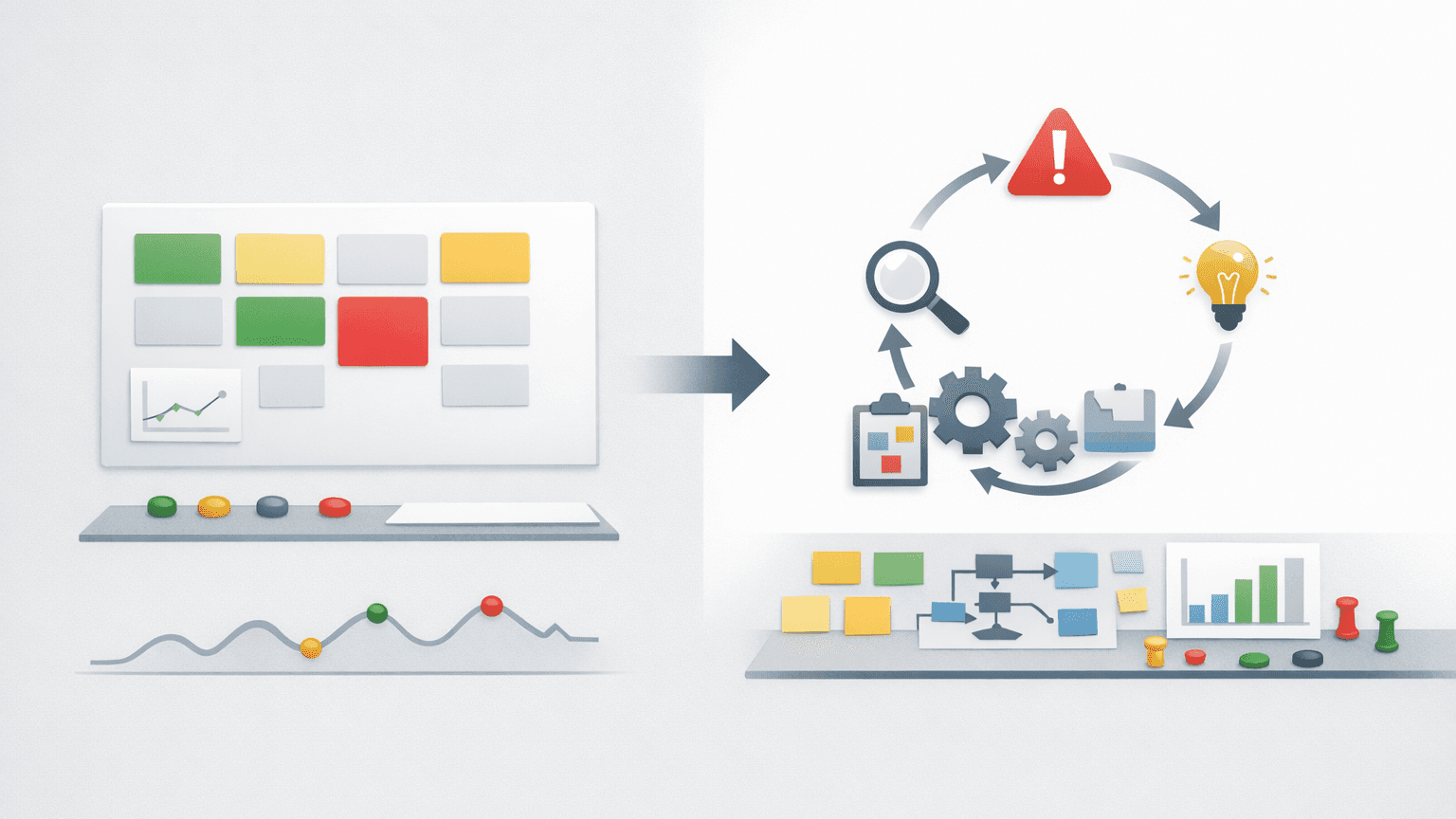
When a structured loop is justified
Open a charter when repeat loss hits a constraint asset despite existing standard work; when safety or quality boundaries approach levels the plant treats as serious; when shifts disagree about machine truth in ways that threaten plan or compliance; or when customer or regulatory traceability needs a defensible chain informal chat cannot provide.
When to stay in standard work
Skip the heavy loop for one-off transients already covered by SOPs, known warm-up behavior with an existing playbook, or issues where containment is complete and recurrence is not indicated. Structure is costly; spend it where informal resolution failed or stakes are high.
Attach IoT evidence deliberately
Bundle stable versus current windows, reasons and overrides, linked maintenance actions, and corroboration notes. The record should allow someone unfamiliar with the drama to reconstruct what the line knew and when.
Name owners and time boxes
Charters without owners become meetings. Assign a lead, define a review date, and track countermeasures like any other operational commitment.
Structured loop trigger check: charter owner named; time box defined; evidence bundle attached; countermeasures tracked; closure reviewed on calendar.
Keep charters small enough to finish
Large charters die of calendar starvation. If the trigger fired, scope the charter to one constraint asset or one failure family, attach IoT evidence as a bundle, and set a hard review date. A closed small charter beats an open grand one.
DBR77 IoT as evidence backbone
DBR77 IoT supports structured solving when visibility exports context the floor already trusts—states, reasons, timestamps—into improvement records instead of orphan screenshots.
Use real-time visibility to trigger structured problem solving when repeats, risk, or traceability demand a record—not for every fluctuation. Discipline preserves energy for problems that deserve it.
Keep the article’s promise practical
Translate the ideas above into one habit your plant can sustain next month: a review that happens, a dictionary people open, a routing rule people trust, or a drill people run. Big programs stall when everything moves at once. Small loops compound when they repeat.
A leadership checkpoint for the next ops review
Ask one plain question: what changed on the floor this month because IoT made reality clearer—not louder? If the answer is vague, tighten scope, definitions, or review cadence before expanding footprint. Useful IoT shows up as calmer handovers, faster confirmation, and fewer circular arguments about what happened. Connection counts are inputs; behavior change is the receipt.
Bringing it home on the floor
None of this advice matters if it stays in a steering deck. The useful test is whether the next shift can act with less debate: clearer states, fewer mystery stops, faster confirmation, and escalation that respects attention. When IoT is working, the line feels less like a courtroom and more like a coordinated team—still loud, still busy, but oriented around the same facts.
If you walk the floor and people still describe the system as “the computer” instead of “our picture of the line,” keep tightening context, ownership, and review until the language changes. Language lag is a symptom that the loop is still too thin.
DBR77 IoT anchors structured problem solving with timestamped machine truth, operator context, and escalation history you can attach to improvement records. Plan a pilot or See online demo.