Why Factories Still Underuse Their Machine Data
Picture a line that is running hard: alarms flash, people move, the schedule is tight. Somewhere in that motion, a stop begins. By the time the story reaches a spreadsheet, the shift has already paid…
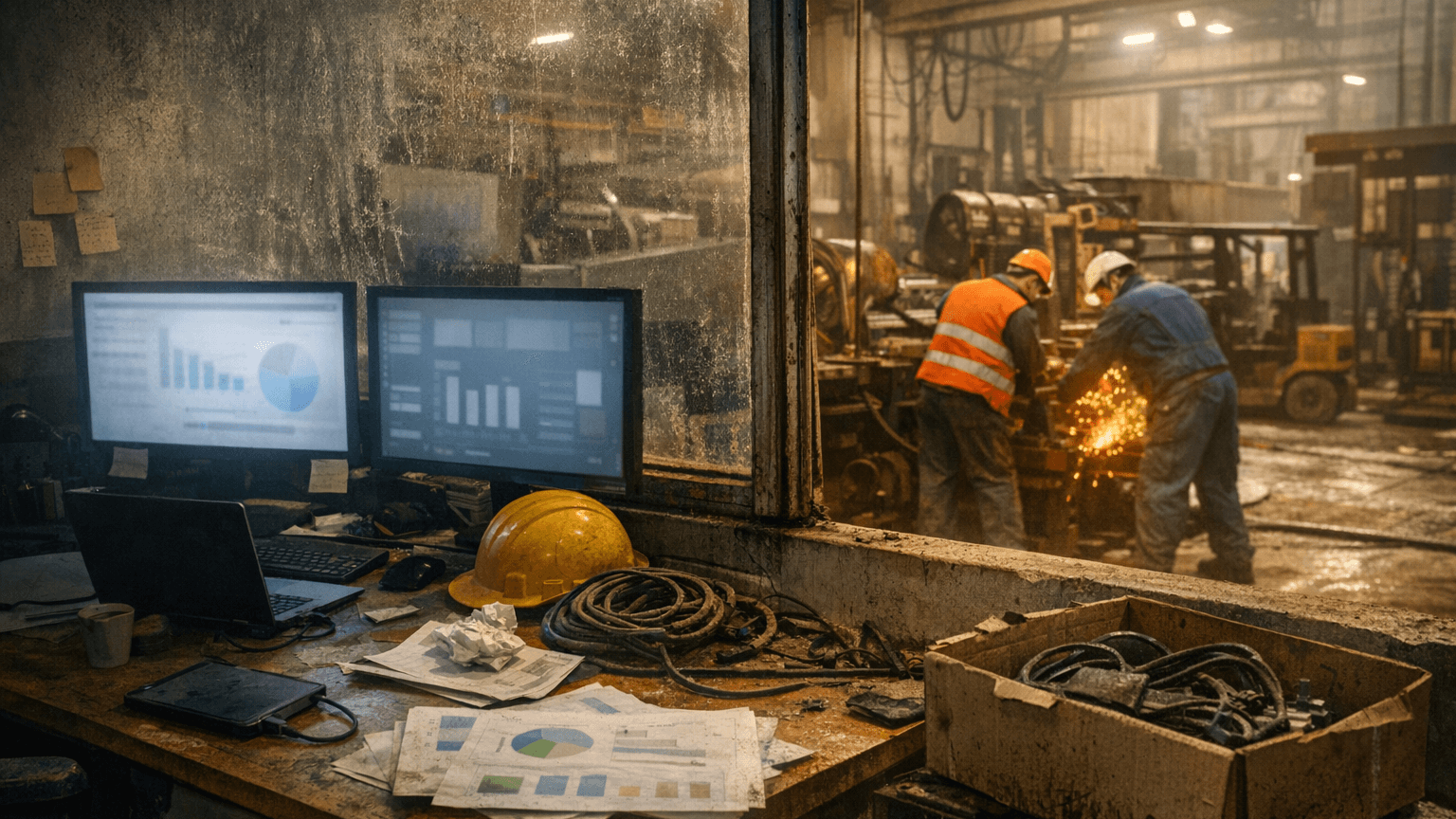
The four places truth gets stuck
In brownfield reality, machine truth often lives in parallel worlds. It sits on the asset, behind a local HMI, or in a SCADA layer the wider organization never quite inherits. It gets summarized into end-of-shift notes that compress complexity into a few words someone will argue about tomorrow. It lives in the experience of a technician who can hear when a line is wrong before any chart agrees.
Each pocket can be useful. None of them, alone, gives the plant a shared operational picture while the shift is still alive. What operations needs is not another archive. It needs a common clock, a common language for stops, and a path from event to explanation that does not depend on heroic memory.
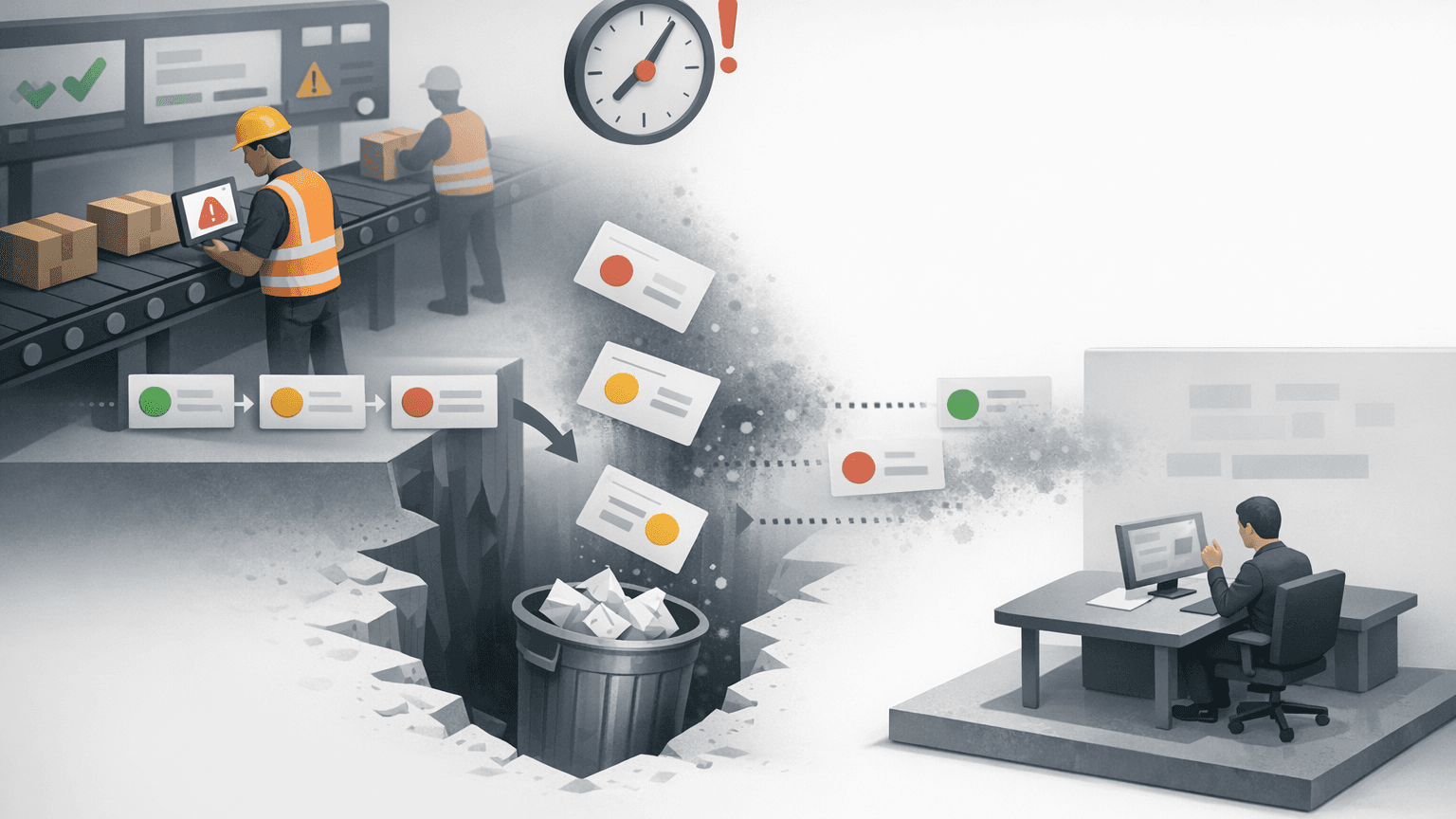
The cost shows up as friction, not as a line item
When visibility arrives late, the plant pays in ways that rarely appear on a capital request. Downtime reasons stay fuzzy, so the same failure mode returns without a clean learning loop. Production and maintenance meet with good intentions and mismatched stories. Small losses—waiting, micro-stops, uneven pacing—compound because nobody sees them early enough to treat them as a pattern rather than noise.
The dangerous part is adaptation. Teams learn to work around the blind spots. The line keeps moving, so the organization mistakes endurance for control. Under the surface, the operation remains reactive: busy, competent, and still one step behind the shift that is actually unfolding.
Why reporting is the wrong place to start the argument
Weekly packs and morning reviews have a job. They help leadership see trends and anchor accountability. They are poor tools for intervention when the issue is happening now. By the time a KPI slide explains last week, the plant is no longer deciding how to rescue Tuesday at two in the afternoon; it is narrating what Tuesday became.
Real-time measurement is not about worshipping dashboards. It is about moving management closer to the moment when intervention still matters. Same-shift clarity changes what questions are even askable: not only “what happened?” but “what can we still change before handover?”
Brownfield humility is a feature, not an apology
A lot of industrial storytelling assumes greenfield conditions: modern machines, clean networks, integrations that behave. Most factories are messier. Mixed vintages, uneven automation, and retrofit constraints are normal. In that world, the winning approach is pragmatic visibility—something you can deploy without pretending the plant will pause for a perfect architecture program.
Retrofit-friendly connection is not a compromise for weak ambition. It is recognition that value has to survive contact with real install windows, real OT boundaries, and real skepticism from people who have seen “digital projects” arrive and fade.
From data layer to control layer
A common trap is to equate collection with progress. Feeds can be live while the organization remains passive. Data becomes operationally useful when it reliably helps the plant detect loss earlier, explain it with enough context to assign ownership, and trigger response while recovery is still plausible. Without that chain, you have instrumentation. You do not yet have control.
Before you scale the footprint, pressure-test the loop: Can the floor trust the signal? Can reasons be captured close to the event? Does escalation have a named owner? Is there a short review habit that turns repeats into decisions?
Useful machine data should make the shift calmer: fewer arguments about what happened, faster alignment on what to do next, and a factual backbone for improvement work that does not depend on whoever happened to be standing nearby when the line stumbled.
What changes when the plant gets this right
Factories that learn to use machine data well do not become perfect. They become more honest and more coordinated. Losses are visible earlier. Conversations skew toward evidence instead of reconstruction. The organization stops paying the invisible tax of working around missing truth.
DBR77 IoT is positioned for that practical job: connect quickly, capture what is happening on the line, make downtime and loss visible in terms people can act on, and support faster response—not as another analytics veneer, but as measurement wired into how the shift actually runs.
The opportunity is not “more data.” It is better decisions while the shift still belongs to you.
DBR77 IoT turns machine signals into same-shift visibility, real downtime truth, and faster operational action. Plan a pilot or See online demo.