Connecting Old Machines Without a PLC: OPC UA, Modbus and Edge Retrofit
DBR77 IoT Team · Published
You can connect old machines without a PLC by fitting a small edge device that reads what the machine already shows: stack light, motor current, a cycle sensor or operator input. Modern machines on the same floor are read directly over OPC UA or Modbus, and both feed one system without replacing any controls or rewiring the line.
"Half our machines are too old to connect" is the objection we hear most. It is also the main reason brownfield floors stay dark. It assumes that visibility needs modern, PLC-equipped equipment. It does not.
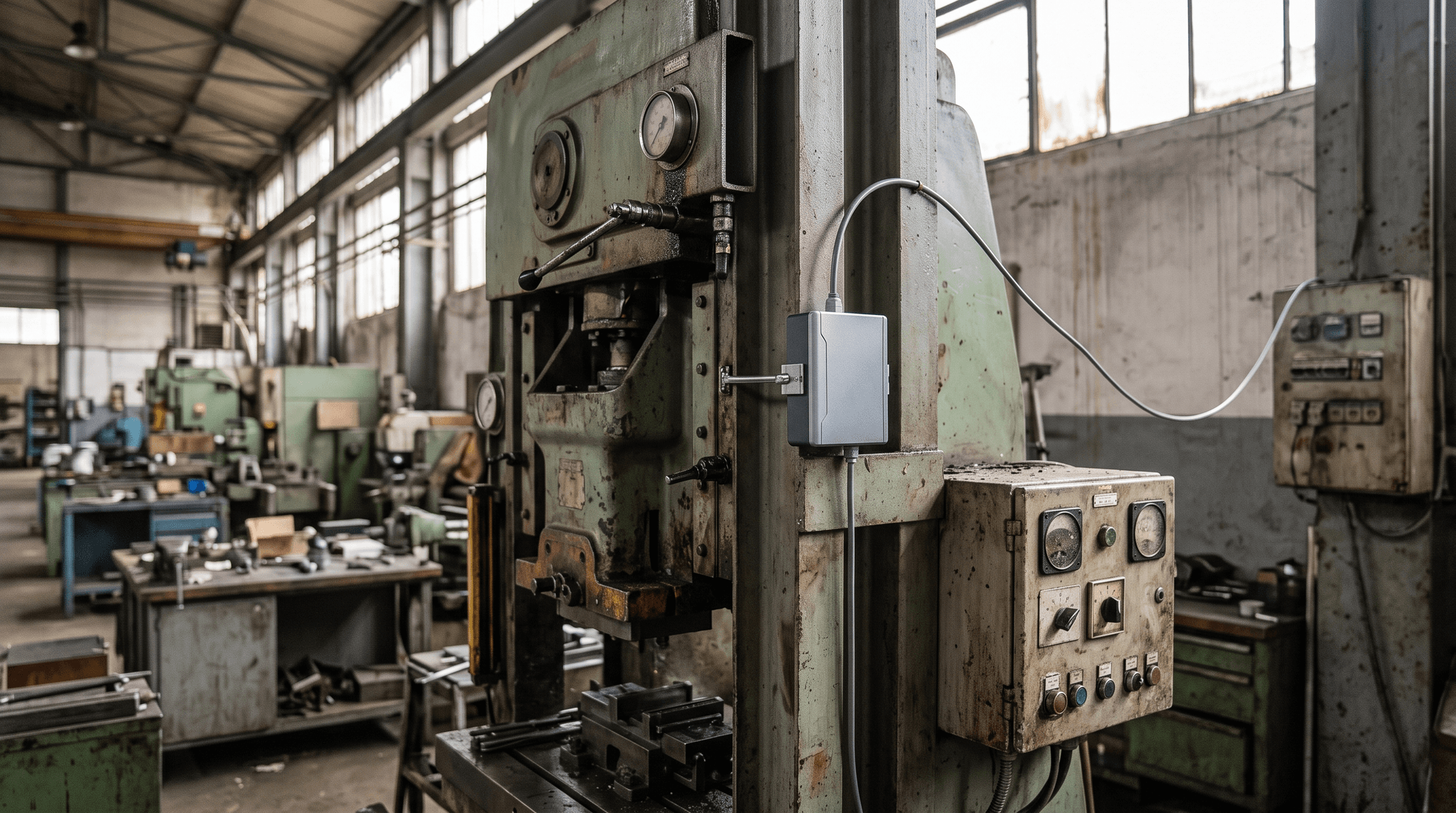
Why "too old to connect" is the wrong question
A 1990s press or a manual lathe does not need to talk like a new machining center. For visibility, you need a few facts from each machine: is it running, idle or stopped, how many parts did it make, and why did it stop.
Most old machines already expose those facts somewhere. A stack light changes color. A motor draws current when it runs. A ram or a spindle passes the same point once per cycle. An operator knows why the machine stopped. The task is to capture those signals, not to modernize the machine.
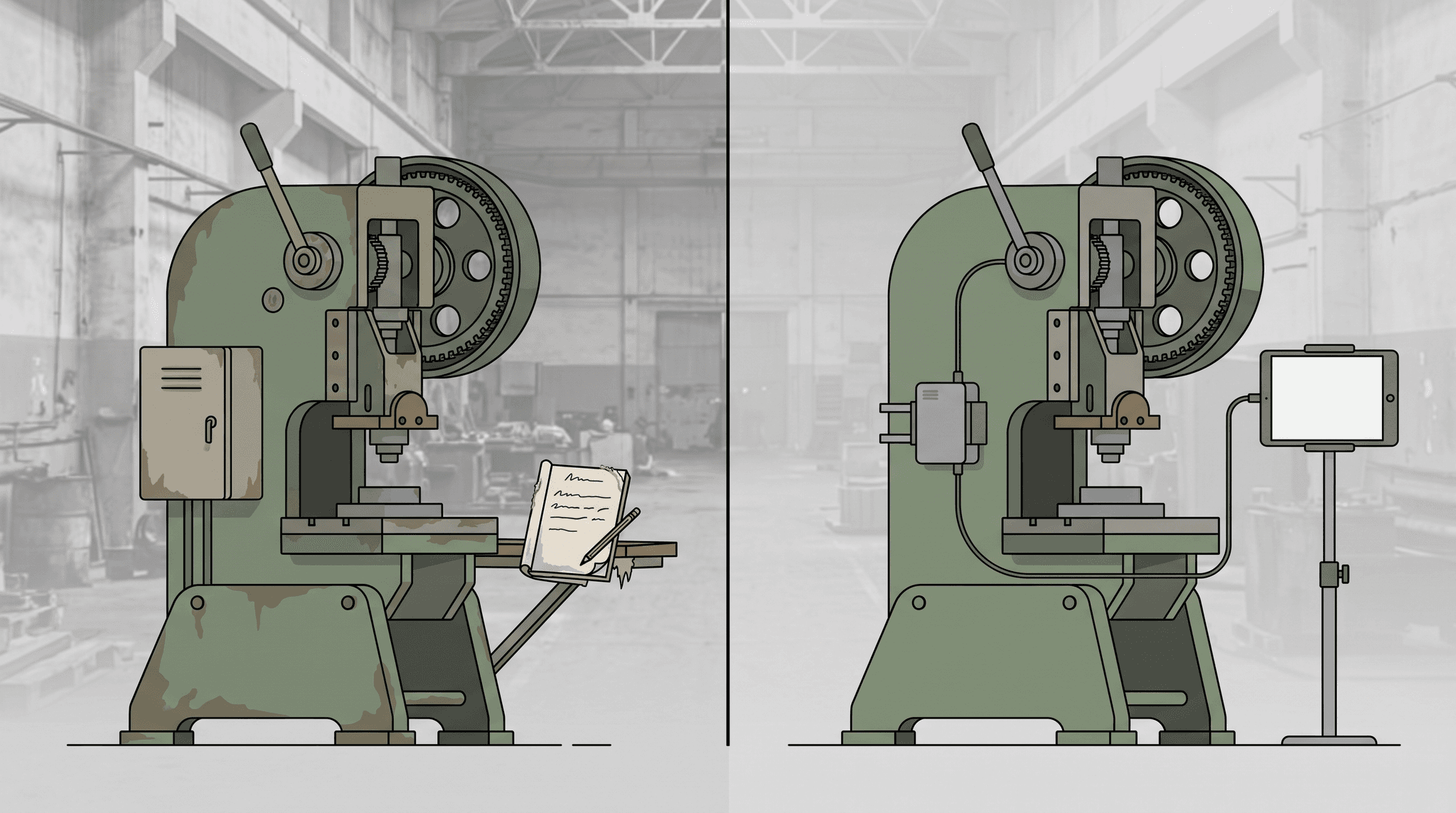
How a mixed legacy floor gets connected
Each machine gets the connection that fits what it has. Nothing in the machine's control logic changes.
| Machine type | How it is connected | What changes on the machine | |---|---|---| | Modern, with PLC and Ethernet | Read directly over OPC UA or Modbus | Nothing; read-only access | | Older, PLC but no network | Edge device on the PLC's serial port (RS485) | Small device in the cabinet | | No PLC, has electrical signals | Edge device reading stack light, current or a cycle sensor | Clamp-on or add-on sensors, no rewiring | | No usable signal (manual station, packing) | Camera as a sensor via IRIS Vision AI | Camera mounted above the station |
OPC UA is a platform-independent standard with built-in security, and the OPC Foundation describes it as the basis for interoperability across the enterprise. Modbus is older and simpler, and the Modbus Organization calls it the most widely adopted industrial protocol. Together they cover most machines with a controller.
The edge devices send their data upward over MQTT, a lightweight publish/subscribe protocol designed for devices with limited memory and bandwidth. The DBR77 IoT integrations page lists the protocols and systems supported.
How fast does this go? A modelled base case for a typical brownfield site shows 11 of 13 machines instrumented and visible in about three weeks. It is a model, and it reflects the usual pattern: most machines are straightforward, and a few need a closer look. The week-by-week plan is in the first 30 days of IoT in a brownfield factory.
Send us your machine list
Share the machines on one line: type, age and controller, if any. In a 30-minute call we go through each one and the connection it needs.
What an edge device reads on a machine without a PLC
On a machine with no controller, the edge device works with whatever the machine gives. Typical sources:
- Stack light or signal lamp. A tap on the lamp circuit, or a sensor on the light, turns green, yellow and red into running, idle and stopped.
- Motor current. A clamp-on current sensor around a supply cable shows whether the main drive is working. No wires are cut.
- Cycle sensor. A proximity sensor or a light barrier counts strokes, cycles or parts.
- Door or guard switch. Useful to separate setup and tool changes from production.
- Operator input. A tablet at the machine for the stop reason. It takes about two seconds and fills the gap no sensor can.
The combination matters more than any single signal. Current alone cannot tell idling from cutting on every machine. Current plus a cycle sensor usually can.
Which network to use on the shop floor
Connectivity should fit the building. Most plants use a mix:
- Wi-Fi where the plant network already reaches. It is the cheapest option when coverage is good.
- LoRaWAN for far corners of large halls, yards and separate buildings. It is a low-power, wide-area standard designed for battery-operated devices.
- SIM (cellular) where there is no plant network at all.
- Wired RS485 or Ethernet for short runs inside a cabinet or between neighboring machines.
Plan the network per machine, as part of the machine list.
Keeping floor data on site: the answer for IT
The second objection usually comes from IT: "We won't send our floor data to someone else's cloud." It is a fair point, and the architecture should answer it.
In DBR77 IoT, processing happens at the edge, on site, inside your IT/OT boundary. Raw signals are turned into states, counts and events locally. Nothing requires shipping raw machine data to a public cloud. For a deeper comparison, see edge vs cloud in manufacturing.
Security reviews in manufacturing usually reference ISA/IEC 62443, the series for security of industrial automation and control systems. NIST's Guide to Operational Technology Security (SP 800-82 Rev. 3) is another common reference. Read-only access to PLCs and separated edge devices make that review shorter. Details are on the DBR77 security page.
Stations with no signal at all
Some stations have nothing to tap: manual assembly, packing tables, very old presses with no usable electrics. For these, a camera can act as a sensor.
The IRIS Vision AI layer runs camera → edge GPU → MQTT → IRIS. The camera measures cycles and presence; the edge GPU processes the images on site and sends events over MQTT. No video is recorded, by design. A pilot uses 2 to 4 cameras, one edge box and a PoE switch, and is installed in a day with no changes to the machines. Our article on cameras as sensors explains when vision is the better choice.
FAQ
Can we really get data from a machine without a PLC?
Yes. An edge device reads available signals such as the stack light, motor current or a cycle sensor. The operator adds the stop reason on a tablet. That is enough for state, counts and downtime reasons.
Do we need to stop production to install the devices?
Usually not. Read-only PLC connections and clamp-on sensors are installed during normal running or planned stops. Nothing in the machine control logic changes.
Should we use OPC UA or Modbus?
Use what the machine supports. Newer controllers often offer OPC UA, with built-in security and richer data models. Many older controllers speak Modbus, which is simpler and widely supported.
Does our data leave the plant?
Not by default. Processing runs at the edge, on site, inside your IT/OT boundary. What goes further, and where, is agreed with your IT team.
What about machines where nothing can be connected?
A camera can act as a sensor. An IRIS Vision AI pilot uses 2 to 4 cameras, one edge box and a PoE switch, installed in a day without touching the machines.
Conclusion
Old machines are not a reason to keep a floor dark. Modern machines are read over OPC UA or Modbus, older ones get a small edge device, and stations with no signal get a camera. Data is processed on site and the network fits the building. Start with the machine list for one line and decide the connection machine by machine.
Find out how your oldest machines would connect
Book a 30-minute call with your machine list. You get a connection plan for each machine and a realistic timeline for one line.
Sources
- OPC Foundation, OPC Unified Architecture
- Modbus Organization, modbus.org
- OASIS, MQTT Version 5.0, 2019
- LoRa Alliance, About LoRaWAN
- ISA, ISA/IEC 62443 series of standards
- NIST, SP 800-82 Rev. 3: Guide to Operational Technology (OT) Security, 2023
- DBR77 IoT modelled base case (brownfield site, 11 of 13 machines), 2026